Want to use the heating mode efficiently this winter? As temperatures drop across the Gold Coast, more homeowners are turning on their air conditioners heating mode to stay warm. But without the right setup or habits, your AC could be wasting energy and running up your power bill.
Table of contents
In this guide, we’ll show you how to use the heating mode efficiently so you stay comfortable without overworking your system. And if you need help along the way, DEEPCHILL is here with expert AC Gold Coast services tailored to your home or business.
How the heating mode works in a reverse-cycle air conditioner
In our previous post, DEEPCHILL gave a general overview of how the heating mode works. However, not all air conditioner models operate the same way in heating mode. Below, we’ll explain how the heating mode works in a reverse-cycle air conditioner.
A reverse cycle air conditioner has a similar structure to a regular cooling AC. However, a reverse-cycle AC has an extra part called the reversing valve, usually placed after the compressor. This valve changes the direction of the refrigerant flow, allowing the system to both cool and heat your space.
This reversing valve is a 4-way electronic valve: 1 inlet and 3 outlets that helps switch the flow direction.
How the heating mode works in a reverse cycle air conditioner:
When heating mode is turned on, the reversing valve is activated. It redirects the gas flow by connecting ports 1 and 4 together & ports 2 and 3 together. At the same time, the indoor and outdoor units switch roles:
The outdoor unit now pulls in heat from outside, while the indoor unit blows warm air into the room.
Here’s a breakdown of the heating cycle:
- Gas from the outdoor unit (in gas form, low pressure, high temperature) flows through ports 2 and 3 of the reversing valve, then passes through a gas trap before entering the compressor.
- In the compressor, the gas is squeezed (compressed), making it hot and high-pressure. It then flows through ports 1 and 4 of the reversing valve into the indoor unit, where it releases heat to warm up the room. As it cools down, it starts turning into a liquid.
- The liquid gas (still high pressure, now lower in temperature) passes through the expansion valve, which lowers the pressure and makes the gas even colder.
- The gas goes through a filter to remove impurities, then returns to the outdoor unit. Here, it releases any remaining cold and turns back into gas (low pressure, high temperature).
- The cycle starts over again: the gas flows through the reversing valve and gas trap, then back to the compressor to repeat the heating process.
How to use the heating mode efficiently without wasting power
Choose the right AC capacity for your room size
When buying an AC, it’s important to pick one with the right power level for your space. Here’s a quick guide:
- Rooms under 15 m2, a 9,000 BTU (1 HP) air conditioner is suitable.
- Rooms between 15 and 20 m2, go for a 12,000 BTU (1.5 HP) unit.
- Room 20 to 30 m2, choose an 18,000 BTU (2 HP) model.
- Larger rooms from 30 to 40 m2, a 24,000 BTU (2.5 HP) air conditioner will work best.
Avoid setting the temperature too high
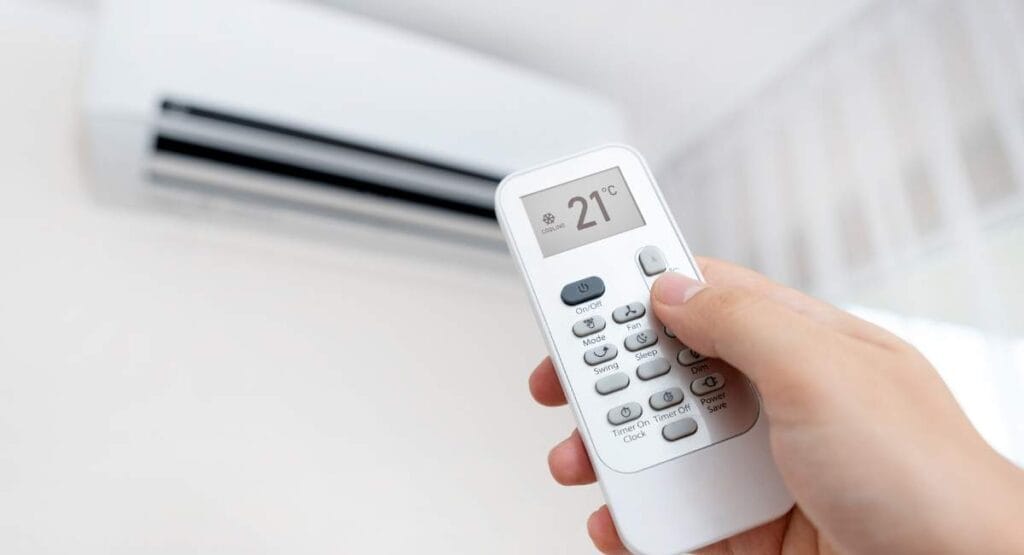
Try not to set the indoor temperature more than 8°C higher than outside as it can cause temperature shock and affect your breathing. A smaller gap also helps cut power bills. In winter at Gold Coast now , lowering the set temp by just 2°C may save over 10% on energy.
Adjust the fan speed smartly
When you first turn on the heater, set the fan to high speed to quickly remove moisture from the room and make the air feel drier and warmer. Once the temperature feels comfortable, switch to a lower fan speed to avoid dry skin and save more energy.
Keep doors and windows closed
Closing doors and windows helps keep warm air in and saves power by blocking cold drafts. But sealing the room too long can make the air stuffy. A good tip: after running the heater for about 4 hours, turn it off and open a window to let in fresh air.
Clean and maintain your AC regularly
Clean the air filters and heat exchanger every 3 to 6 months, depending on how often you use the AC. This keeps the system running efficiently and helps prevent dust and mold buildup. A clean filter can also cut power use by up to 15%, saving you money on your energy bills.
By following these simple tips, you will know how to use the heating mode efficiently this winter to stay warm and energy-efficient all winter long. Need help installing, servicing, or optimising your AC? Contact DEEPCHILL for expert AC Gold Coast services.